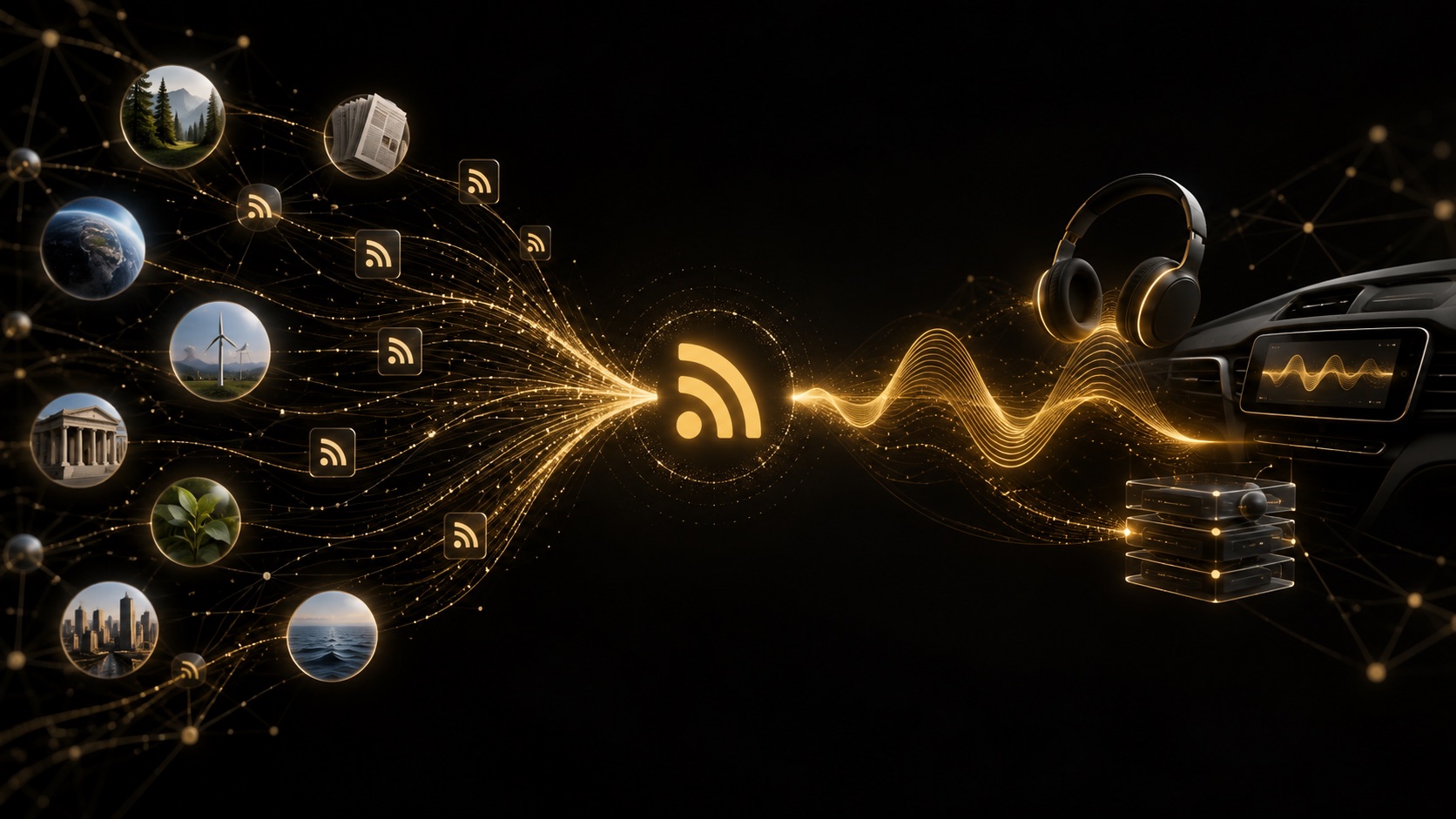
Two groups of people are pulling technology in what look like opposite directions, and RSS sits right where they meet.
One group is tired of Big Tech deciding what they see. They want out of the algorithm, off the closed platforms, back to something open that they control. You can see it in the move to Mastodon and Bluesky, in the return of the personal newsletter, in the general fatigue with feeds that are tuned to keep you scrolling rather than to inform you. These people want to own their sources again.
The other group wants more. Not more noise, but more capability. They want to listen to their news, not just read it. They want it summarised when they are short on time, organised when there is too much of it, and available in the car without touching a screen. They grew up with apps that are fast, beautiful, and do the work for them, and they are not going to accept something that feels like software from 2005.
For a long time, RSS could serve the first group but not the second.
The reason RSS stayed niche
RSS has been around for over twenty years, and it does something genuinely good: it lets you subscribe to any site's updates without an account, without an algorithm, without asking anyone's permission. You pick the sources. That is exactly what the first group wants.
But classic RSS readers were built for people who already understood RSS. They gave you a list of links and a river of headlines, and not much else. You had to know what a feed was, find the feed URL yourself, and accept an interface that prioritised function over feeling. For anyone outside the small circle of people who cared, it was too much work for too little reward. So RSS became a tool for a technical minority, while everyone else drifted to the algorithmic feeds that required no effort at all.
The gap was never really about the protocol. RSS was fine. The gap was everything built on top of it, or rather everything that was not.
What AI is changing
This is where the last couple of years get interesting. A wave of new apps is using AI to fill in exactly the parts that kept RSS out of most people's hands.
Finding feeds used to mean digging through a site's source code. Now an app can take a homepage, work out the real feed, and check that it actually works, without the user ever seeing a URL. Reading used to be the only option. Now the same feed can be read aloud in a natural voice, or turned into a short summary when you only have a minute. Organising dozens of sources used to be manual. Now it can happen on its own, on your device, learning what you actually read.
None of this changes what RSS is. The protocol underneath is the same open, account-free format it always was. What changed is that the friction is gone. A person who has never heard the letters R, S and S can now use it every day without knowing it, because the app does the technical part quietly in the background.
That is the shift worth noticing. RSS is not becoming mainstream by being explained to more people. It is becoming mainstream by disappearing into apps that make it feel like anything else.
The tension, and how it resolves
There is a real tension in all this. Openness usually means simple and self-hosted. Rich features usually mean a closed app, a cloud service, an account, and a company sitting between you and your data. Historically you picked one or the other.
The interesting apps now are the ones that refuse to pick. They keep RSS open and account-free, they keep your data on your device, and they add the modern features on top without taking the control back. You get the audio, the summaries, the discovery and the clean interface, but the sources are still yours and the choices are still yours. Open underneath, capable on the surface.
This is the part that matters most, and it is the reason the two groups from the beginning are closer than they look. The person who wants decentralisation and the person who wants features are not really at odds. They both want the same thing in the end: technology that serves them instead of managing them. RSS, with the right layer built on top, happens to be one of the few places where you can actually give them both.
Where this goes
So no, RSS is not about to explode. That is not how it works, and anyone promising a boom is selling something. What is happening is quieter and more durable. The protocol that a technical minority kept alive for two decades is finding a much wider audience, because a new generation of apps is doing the work that RSS readers never did.
Owning your sources is becoming easy enough that you no longer have to be the kind of person who owns their sources. That is a small sentence with a large consequence. It is also, more or less, the whole reason we are building Safe & Informed.
Related reading: Imagine a different way to follow the news and How to listen to your news hands-free in the car.